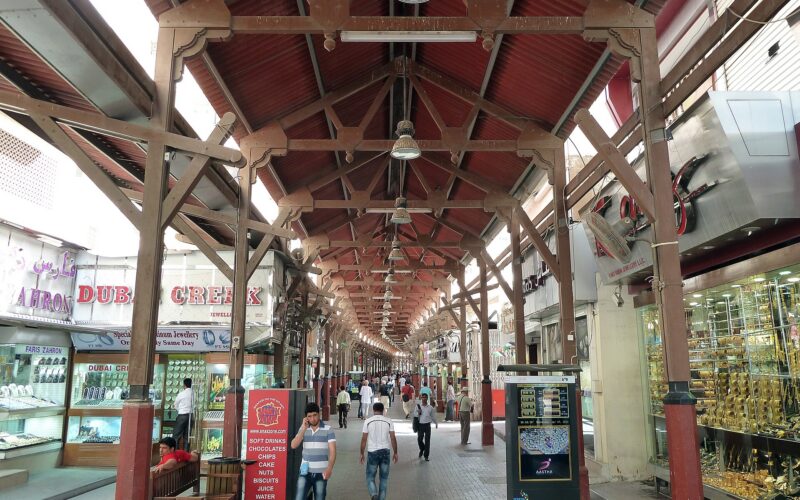
Before the malls there were the souks of Old Dubai, and they are still there, on both banks of Dubai Creek: the Gold Souk and Spice Souk in Deira, the Textile Souk in Bur Dubai, and an abra ride for one dirham between them. This is the Dubai that trading built – Iranian, Indian and Emirati merchants in covered alleys, shopkeepers who expect you to negotiate, saffron by the kilo and gold by the gram. In winter it is finally comfortable to walk here in the afternoon, and the late-afternoon light on the Creek is the best in the city. Half a day is enough; go from 16:00 to 21:00.
Gold Souk, Deira
More than 300 jewellers along a covered lane, with windows so densely hung with 22-carat gold that the whole street glows. Gold is sold by weight at the day’s rate plus a making charge, and the making charge is where you negotiate – a 20 to 30 percent reduction is normal, and paying cash helps. The Dubai government tests and guarantees purity, so the risk is the price, not the metal. Even non-buyers come for the world’s heaviest gold ring (63.85 kg) in the window of Kanz Jewels and the wedding-set displays. Open roughly 10:00–22:00, with many shops closed 13:00–16:00 and Friday mornings.
Spice Souk
Two minutes from the gold, the Spice Souk is smaller than the guidebooks suggest but worth it for the smell alone: sacks of dried limes, rose petals, frankincense, saffron, cinnamon bark and dried hibiscus, plus the tourist trade in oud, incense burners and pashminas. Buy saffron here (ask for Iranian, check the threads are deep red without yellow) and Omani frankincense; skip anything pre-packaged. Prices start at roughly double what a local pays – offer half and meet in the middle with a smile.
Textile Souk, Bur Dubai, and the abra
Cross the Creek on an abra – the open wooden water taxi, AED 1 per person, five minutes, no timetable, it leaves when full – to the Bur Dubai side and the Textile Souk: a restored covered lane of silk, cotton and cashmere shops with tailors who will make a shirt or a dress in 24 hours. Behind it lie Al Fahidi, the wind-tower heritage quarter with the Coffee Museum and small galleries, and Al Seef, the new waterfront promenade built in old style, where the cafés with Creek views are. This bank is the one for dinner.
Tours and dhow cruises
The souks are best with a guide the first time – the alleys are confusing, the bargaining has rules, and the street food (chapati rolls, karak tea, camel-milk ice cream) is half the experience. A guided walking tour with abra ride and tastings takes about three hours; a dinner dhow cruise on the Creek – wooden boat, buffet, the lit-up souks gliding past – is the winter-evening classic. Both below through GetYourGuide, with free cancellation.
Getting there and staying nearby
Take the green metro line to Al Ras (Gold and Spice Souks, five minutes on foot) or Al Ghubaiba (Textile Souk and Al Fahidi). From Downtown it is 25 minutes with one change. Taxis are cheap but the lanes are pedestrian, so you walk the last part anyway. Deira has Dubai’s most affordable hotels, several within a stroll of the souks; see our Old Dubai and Deira hotel guide or compare Deira hotels on Booking.com. For the modern malls, see shopping in Dubai in winter.
Good to know
Often, yes: no VAT for tourists who reclaim it, low making charges and daily rates. The saving is in the making charge you negotiate, not the gold price itself, which is set by the market.
Roughly 10:00–22:00 daily, but many shops close between 13:00 and 16:00 and open late on Fridays. Evenings from 17:00 are the best time in winter.
AED 1 per person for the public abra between Deira Old Souk and Bur Dubai stations. It runs all day and evening, leaving when full.
Yes, and you are expected to – except at fixed-price places like Souk Madinat. Start at about half the asking price and settle around 60–70 percent.
Al Ras on the green line, a five-minute walk. Al Ghubaiba serves the Bur Dubai side and the Textile Souk.